


DTECT® Object 3D: practical 3D detection without vision complexity
In modern production and assembly processes, detection is becoming increasingly complex. Simply determining whether an object is present is often no longer sufficient. Aspects such as completeness, orientation and reliability play an increasingly important role, even with low contrast or varying positions. At the same time, the need for easy integration and stable operation remains undiminished. This is changing how detection is applied in practice.
3D detection without additional system complexity
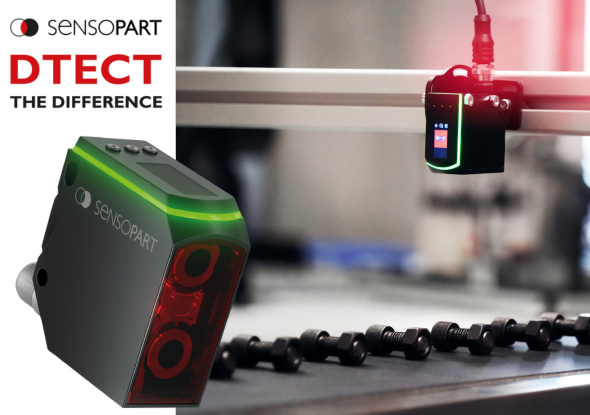
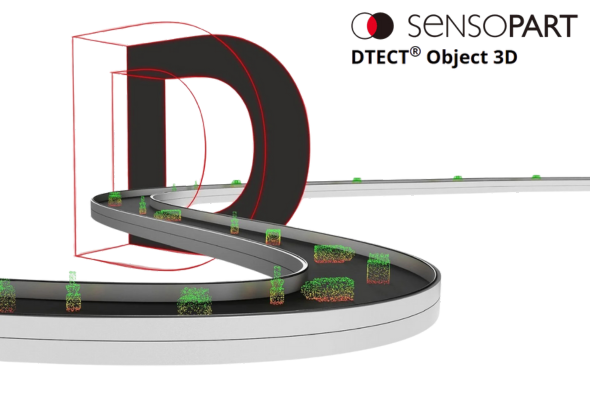
The DTECT® Object 3D from SensoPart fits seamlessly into this development. This industrial sensor uses 3D information to evaluate objects based on surface area and volume, while retaining the ease of use, integration characteristics and compact size of a classic industrial sensor. This makes it a suitable solution for applications where 2D detection falls short, without introducing additional system complexity.
When 2D detection is no longer sufficient
Conventional optical sensors, such as colour and detection sensors, are fast and robust, but remain dependent on contrast, colour and reflection. This makes them sensitive to situations such as black on black, glossy surfaces or varying object positions, often requiring additional mechanics.
The step towards vision
Industrial cameras technically offer more possibilities, but also introduce additional complexity. In addition to the camera(s), lighting, vision software, licenses and specialist knowledge are required. This results in longer commissioning times and higher engineering costs, while this is not always necessary. With the use of vision cameras, commissioning has already become easier thanks to ready-to-use, often free software packages. However, complex camera settings and the use of separate lighting are still required in many cases.
In practice, this creates the need for a solution that goes beyond 2D, without becoming complex.
A different approach to detection
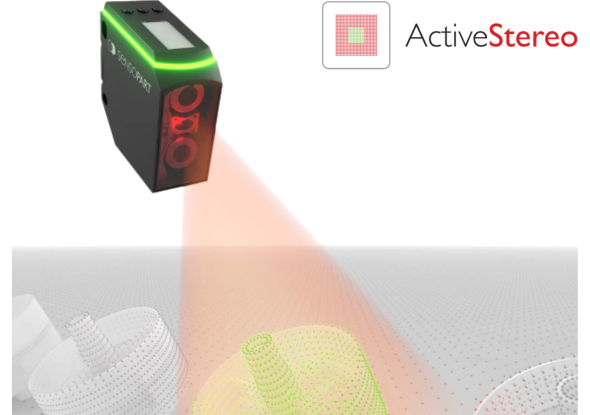
The DTECT® Object 3D therefore takes a different approach. Using active stereo technology, the sensor evaluates objects based on surface area and volume, rather than contrast or colour. The result is a simple OK/NOK switching output (OK/NOT OK) that can be processed directly, yet is based on true 3D information. Thanks to its high scan rate, this approach is suitable for dynamic processes, without the need for external lighting, a PC, software or licences.
Connect, teach in, ready
Configuration is carried out directly on the sensor. Using the integrated colour display and control buttons, parameters such as the field of view and the relevant height can be set quickly and easily, without an external PC or vision software. The all-round visible status lighting immediately shows the status and the OK/NOK result. With the DTECT® Object 3D, 3D detection really is a matter of connect, teach in, ready.
Want to learn more about the SensoPart DTECT® Object 3D?
Then click ‘Request the whitepaper’ and we will send you the whitepaper as soon as possible.
Video: DTECT® Object 3D, first active-stereo-based sensor
What sets the DTECT® Object 3D apart
Many detection solutions are designed around existing technology: either as a simple sensor, or as a vision solution with associated complexity. The DTECT® Object 3D has been developed from a different perspective. Not by simplifying or extending existing systems, but by rethinking what is actually required in practice for reliable 3D detection. This approach results in five clear design choices that together define what sets the DTECT® Object 3D from SensoPart apart.
1. Object-based 3D detectionThe DTECT® Object 3D evaluates objects based on their spatial geometry, such as shape, height and volume. Detection is therefore based on what is physically present, not on how an object appears. This makes the sensor suitable for applications where colour, contrast or surface structure vary and cannot provide a reliable basis for detection. |
2. Active stereo for stable measurementsThe 3D information is generated using active stereo and infrared projection. By actively projecting a fixed pattern onto the object, reproducible 3D data is created, even with low texture or homogeneous surfaces. This ensures stable measurements under conditions where other 3D technologies are more sensitive to variation. |
3. Suitable for dynamic processesWith a scan rate of up to 100 frames per second, the DTECT® Object 3D can reliably evaluate objects, even when they are moving, tilting or only briefly present within the detection area. This makes the sensor suitable for dynamic processes such as conveyor systems and vibratory feeders. |
4. Full 3D detection in a compact formDespite its full 3D functionality, the DTECT® Object 3D is housed in a compact industrial enclosure. This allows the sensor to be used in locations where traditional 3D cameras or vision solutions are too large, too complex or impractical. |
5. Reference-based evaluation without image analysisThe generated 3D data is not interpreted as an image with individual pixels and raw data, but is translated directly into a clear evaluation. The DTECT® Object 3D operates with fixed decision logic and provides a clear OK/NOK signal to the control system. This keeps complexity within the sensor itself and eliminates the need for parameterisation, image interpretation or vision software in the installation. The decision logic is created via a simple reference teach-in directly on the sensor. A correct situation is taught, which is then continuously compared with the current 3D measurement during operation. This makes setup fast, reproducible and transparent. |
Application example 1:
Completeness check of products on conveyor systems
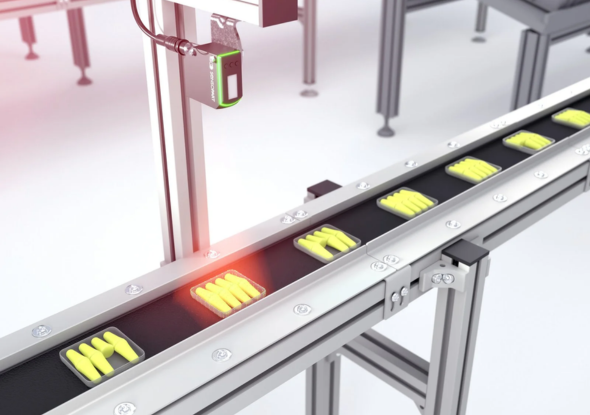
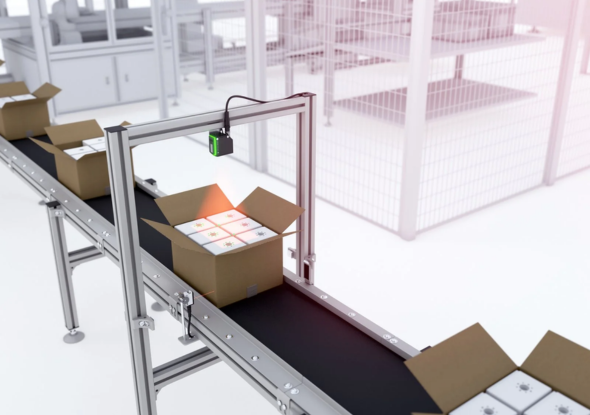
In production and packaging lines, completeness checks are often more complex than they may appear at first glance. Products consist of multiple components, may be positioned unevenly or vary slightly in placement. In such situations, conventional detection solutions rely heavily on contrast, fixed positions or additional mechanics, which limits flexibility.
How the DTECT® Object 3D approaches this
The DTECT® Object 3D takes a fundamentally different approach to completeness checking. Instead of detecting individual components, the sensor evaluates the overall object volume and its spatial distribution. Missing or incorrectly positioned components immediately result in a deviating 3D profile, even when the product appears to be complete.
What this delivers in practice
Thanks to its high scan rate and object-based evaluation, this inspection remains reliable in continuous product flows. This makes the DTECT® Object 3D particularly suitable for completeness checks in dynamic processes, without the need for additional mechanical guides or complex vision setups.
Application example 2:
Inspection of filled boxes and containers
In logistics and assembly processes, it is essential to determine whether boxes or containers are filled correctly and completely. This inspection is often challenging when products overlap, vary in height or are not always positioned in exactly the same way. Visual inspection or 2D detection quickly fall short in such cases.
Three-dimensional evaluation of the contents
The DTECT® Object 3D evaluates the contents of a box or container three-dimensionally, focusing not on individual products, but on the overall volume distribution within the detection area. Deviations, such as missing items or incorrect filling, are reliably detected regardless of colour, reflection or product shape.
Easy integration into existing lines
Because the sensor operates autonomously and provides a direct OK/NOK signal, this inspection can be easily integrated into existing lines. This makes the solution suitable for processes where reliability is more important than visual detail.
Want to learn more about the SensoPart DTECT® Object 3D?
Then click ‘Request the whitepaper’ and we will send you the whitepaper as soon as possible.
Applicatievoorbeeld 3:
Reliable presence detection with varying positions
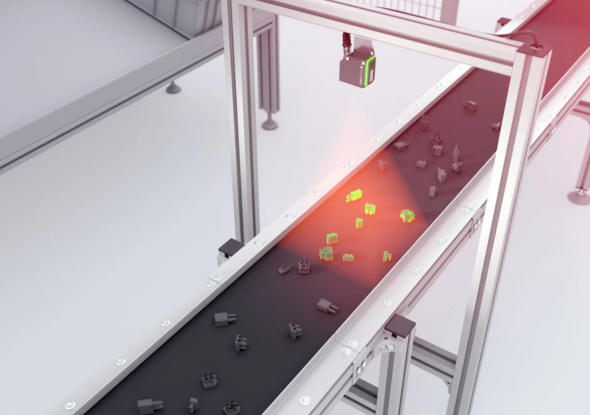
Presence detection may seem straightforward, but becomes complex when objects are not always in exactly the same position, tilt or are in motion. In such situations, conventional sensors may generate false detections or require additional mechanics to position objects.
Presence as a spatial assessment
The DTECT® Object 3D addresses this by treating presence not as a point detection, but as a spatial assessment. The sensor detects whether actual object volume is present within a defined area, regardless of small shifts or orientation differences.
Reliable with variable infeed
Thanks to this approach, detection remains reliable in processes with variable infeed or limited positioning accuracy. This makes the DTECT® Object 3D suitable for presence monitoring in modern, flexible production lines.
Application example 4:
Position monitoring in vibratory feeders and conveyor systems
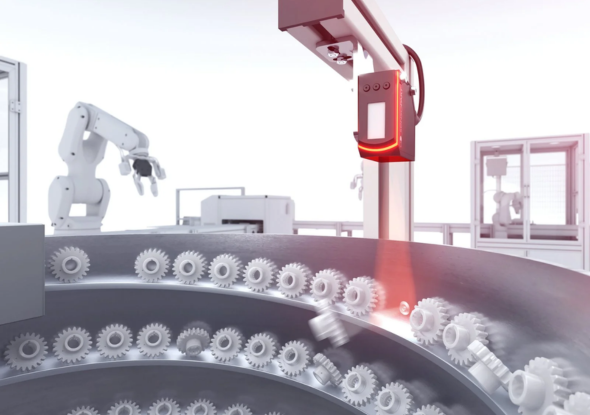
In vibratory feeders and similar transport systems, objects move continuously and unpredictably. Objects may tilt, accelerate or be visible within the detection area only briefly. Traditional detection solutions often rely on mechanical guides or multiple sensors in these situations.
Combination of speed and spatial detection
The DTECT® Object 3D combines a high scan rate with spatial assessment, enabling reliable detection even with fast or irregular movements. The sensor can determine whether an object is located within a defined 3D zone, without requiring precise positioning.
Less mechanics, more stability
This enables reliable position monitoring in dynamic transport systems, while keeping installation simple and clearly structured. Additional mechanics or complex vision setups are not required.
Application video: reliable orientation control of components
Intelligent Detection
The DTECT® Object 3D is just one part of the Intelligent Detection knowledge area of fortop. This knowledge area covers a wide range of solutions for detecting, positioning, recognising and inspecting objects and processes in industrial environments and machine building.
Within Intelligent Detection, this includes, among others:
* Distance sensors
* Colour sensors
* Vision cameras
* VISOR Robotic
* BlueLight sensors
Depending on the application, the technology is selected that provides the right solution, from simple to, where required, advanced detection. fortop supports machine builders in selecting and combining these solutions, ensuring that detection matches the process, the environment and the desired level of automation. Intelligent Detection therefore forms a coherent knowledge area in which a suitable solution is available for a wide range of detection challenges.

